Subject: This letter serves as official documentation from the manufacturer regarding the internal topology and zero-export fail-safe mechanisms of the S6-EH2P(9.6-16)K-SV-YD-L-US series intended for installation within your utility jurisdiction.
1. Internal Topology and Operational Logic
The Solis inverter system operates as a closed-loop Power Control System (PCS). To accurately monitor and manage the power exchange (import and export) between the premises and the utility grid, the system utilizes a dedicated external meter paired with ≤ 0.5% accuracy Current Transformers (CTs). These CTs are installed at the utility point of common coupling where they can measure the full power exchange between the home and the utility company. The external meter communicates site-level energy data back to the inverter's Digital Signal Processor (DSP)
in real-time via a hardwired communication protocol (RS485/Modbus). When the system is configured for a Zero-Export profile, the inverter's DSP continuously processes these telemetry measurements. It dynamically curtails Photovoltaic (PV) power generation to strictly match the instantaneous local load demand and, if applicable, battery charging requirements, ensuring that the net power exported to the utility grid remains at
0kW.
2. Export Power Control Setting
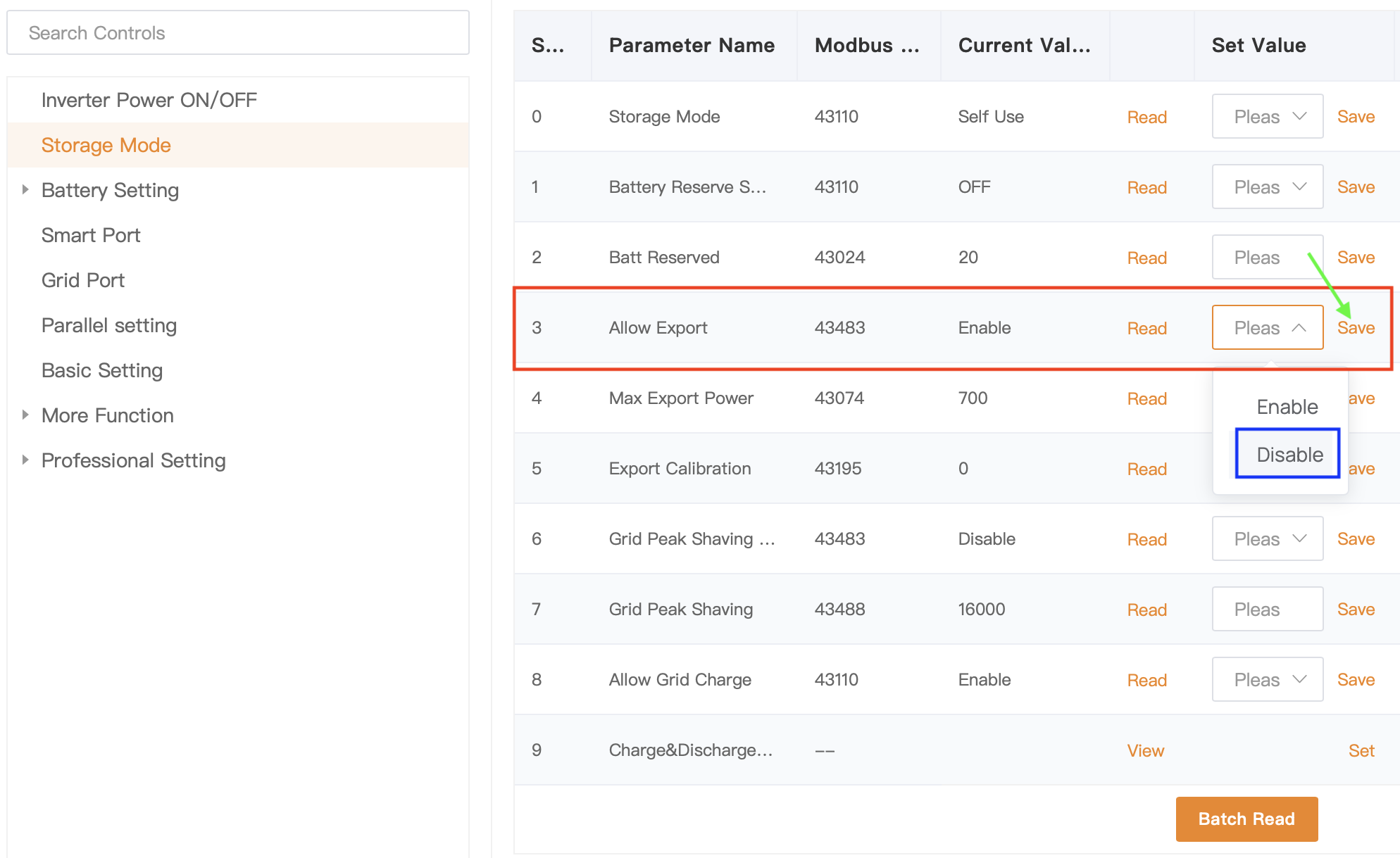
To limit the export power of the system to 0 kW first go to the Storage Mode settings menu within the inverter settings. The “Allow Export” setting
should be changed from Enable to Disable by clicking the field in the Set Value column and then clicking “Disable”. Lastly, click “Save” just to the right of the field to change the setting to Disable. Doing this ensures the system does not export any power to the utility.
3. FailSafe Setting in the Event of Meter or CT Failure
The system is equipped with a dedicated, firmware-level “FailSafe” parameter designed specifically to protect the grid integrity in the event of hardware or communication loss. Should the CTs or the external meter experience a hardware failure, or should the communication between the meter and the inverter be interrupted (e.g., a severed RS485 cable, loss of Modbus polling, or physical damage to the CTs or CT wires), the inverter instantly registers a loss of the critical reference signal. Upon this detection, the programmed FailSafe alarm feature engages within a few seconds.
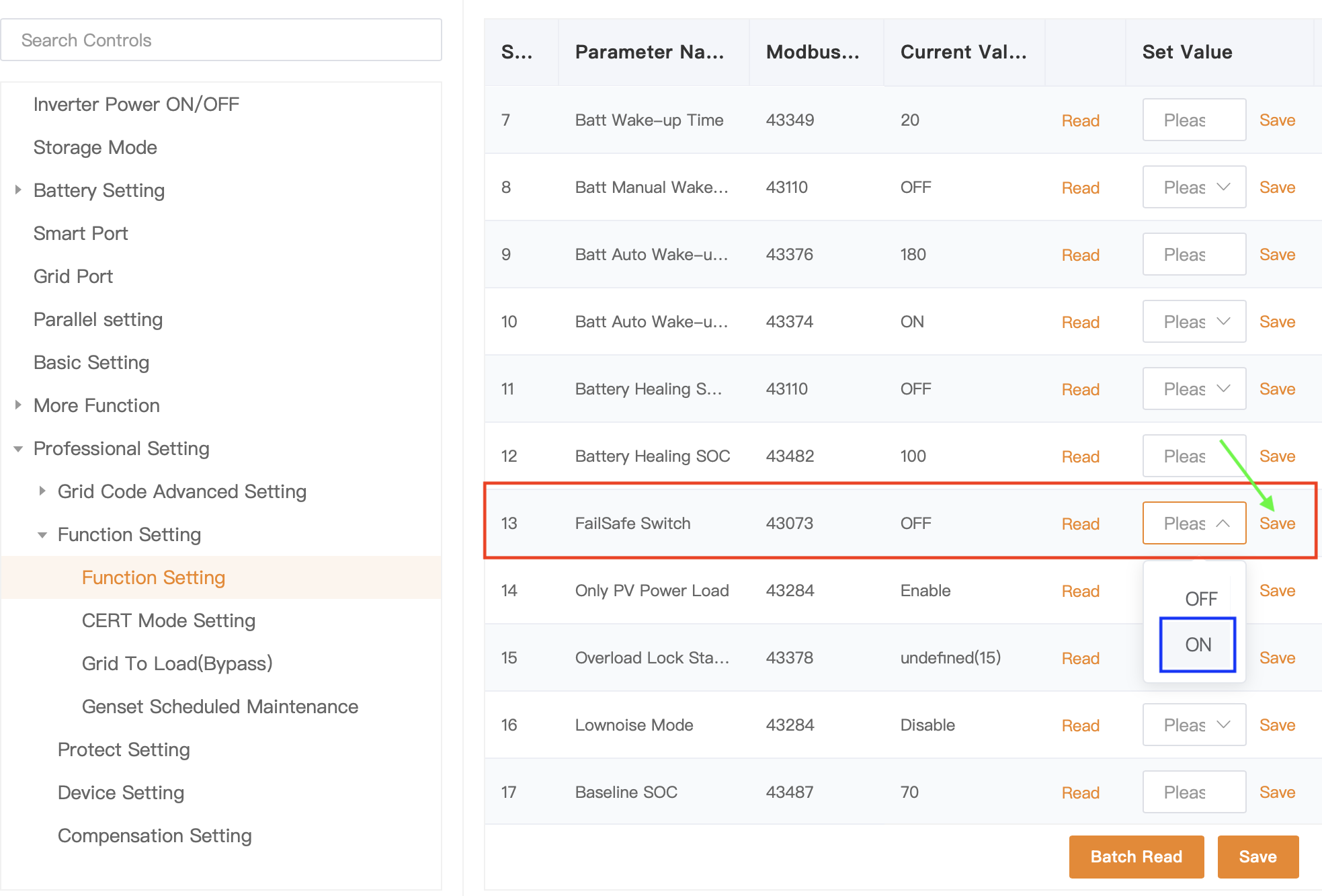
When the Fail-Safe is triggered, the inverter's control logic systematically shuts down active power output, throttling PV production to exactly 0kW. The system remains locked in this secure, non-exporting state and will not resume standard PV production or export until the physical meter or CT communication has been successfully restored and verified by the system. The FailSafe setting is located within the “Function Settings” of the inverter. Click the white box in the “Set Value” column, then click ON, and then click “Save” just to the right of the setting.
4. Official Confirmation
Solis officially confirms and attests that under no circumstances can the aforementioned inverter models backfeed power into the utility grid in the event of a meter failure, CT failure, or communication loss between the measuring equipment and the inverter. The internal topology guarantees a default to a 0kW generation state to ensure absolute grid safety. Should your engineering team require further technical clarification, please do not hesitate to contact our product management team directly.
If you have any questions, please reach out to the US Solis Support team for assistance:
Email: usservice@solisinverters.com & phone: +1(866)438-8408
Michael Allen, Product Manager
michael.allen@solisinverters.com
Solis North America
Was this article helpful?
That’s Great!
Thank you for your feedback
Sorry! We couldn't be helpful
Thank you for your feedback
Feedback sent
We appreciate your effort and will try to fix the article