Note: This article is only for S6-EH3P(30-60)K-NV-YD-H-US commercial 480VAC hybrid inverter series for the US and Canada including the following Solis hybrid inverter models:
S6-EH3P30K03-LV-YD-H-US(21A)
S6-EH3P30K03-NV-YD-H-US(21A)
S6-EH3P40K04-NV-YD-H-US(21A)
S6-EH3P50K04-NV-YD-H-US(21A)
S6-EH3P60K04-NV-YD-H-US(21A)
Understanding UL 1741 SB: The "Three-in-One" Certification
UL 1741 SB (Supplement B) is the current benchmark for grid-interactive smart inverters. It ensures that the inverter complies with the latest IEEE 1547-2018 standards, equipping the hardware to actively support grid stability through advanced functions like voltage ride-through, frequency regulation, and reactive power support.
However, achieving UL 1741 SB for the S6 series is actually a massive three-in-one testing accomplishment. To meet the stringent requirements of the Supplement B standard, the inverter must also simultaneously pass two other critical safety evaluations:
UL 1998 (Software in Programmable Components): Because modern smart inverters rely heavily on software to manage protective functions and grid interactions, the code itself must be bulletproof. UL 1998 evaluates the functional safety of the software, ensuring that microcontrollers and algorithms will fail safely and operate reliably under fault conditions.
UL 1699B (Photovoltaic DC Arc-Fault Circuit Protection): Commercial solar arrays carry significant DC voltages. UL 1699B tests the inverter’s integrated Arc-Fault Circuit Interrupter (AFCI) capabilities. This ensures the system can rapidly detect and mitigate DC arcing faults, drastically reducing fire risks.
By rolling UL 1998 and UL 1699B into the overarching UL 1741 SB evaluation, the S6 series was proven to have ironclad software reliability, advanced fire safety, and modern grid-support capabilities all operating cohesively.
Understanding UL 3141: Power Control Systems (PCS)
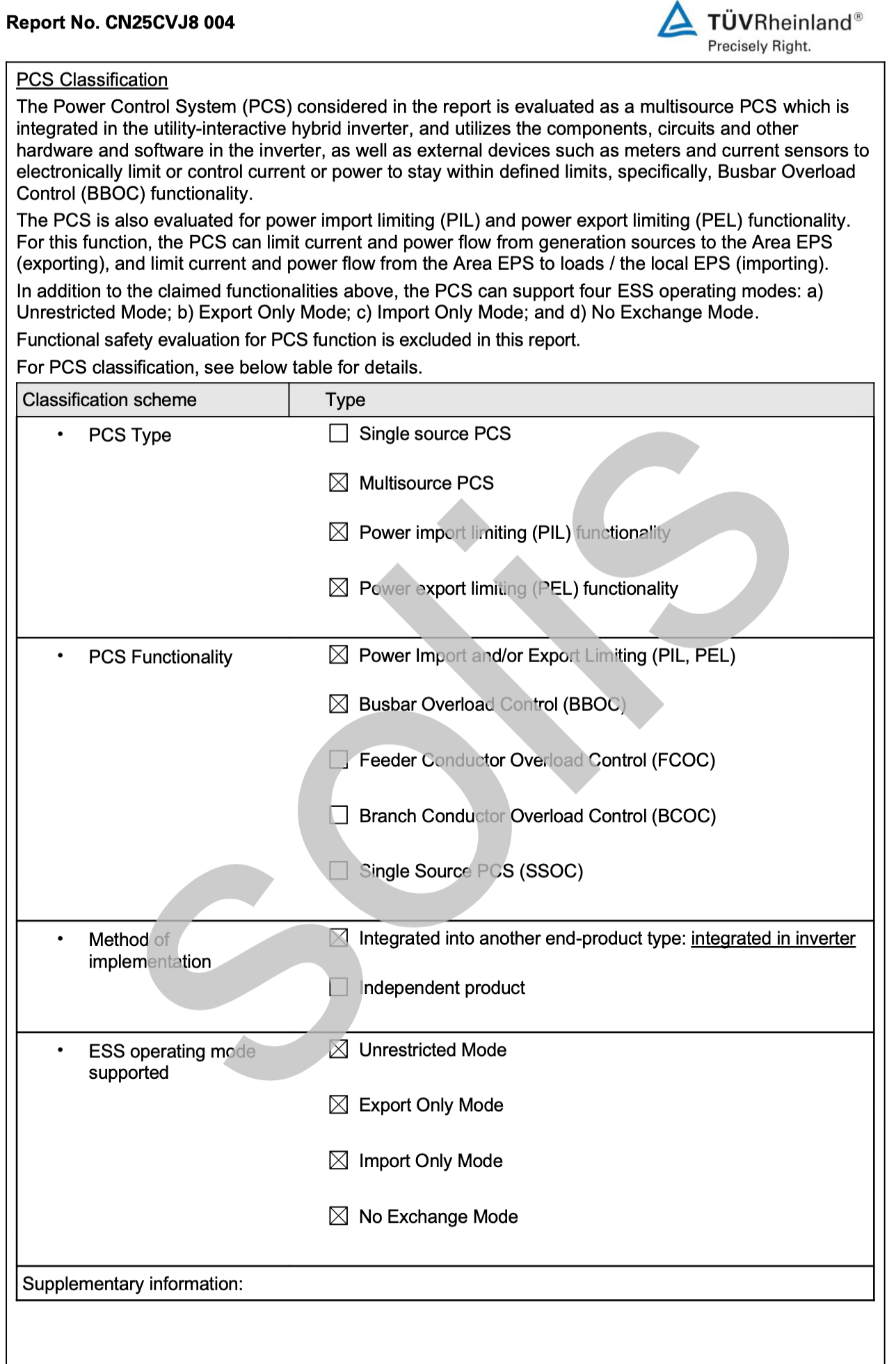
The UL 3141 standard rigorously evaluates how an inverter electronically manages power flow, ensuring it can safely limit current without solely relying on traditional hardware like circuit breakers. For the S6 commercial hybrid inverter series, the PCS functionality is entirely integrated into the inverter itself, meaning no external, third-party PCS hardware controller is required to achieve these capabilities.
Here is exactly what the S6 series is certified to do under its UL 3141 classification:
Certified PCS Functionalities (Tested and Approved)
Multisource PCS: The system is officially classified to manage and regulate power from multiple sources simultaneously (e.g., PV, Energy Storage, and the Grid).
Power Export Limiting (PEL): The inverter can electronically cap the maximum amount of power sent back to the utility grid. This is critical for sites with strict interconnect agreements or zero-export requirements.
Power Import Limiting (PIL): The inverter can restrict the maximum amount of power drawn from the grid (for instance, to charge the battery bank), ensuring the site does not exceed its allowed electrical service capacity.
Busbar Overload Control (BBOC): This is one of the most valuable certified features. The inverter dynamically monitors and controls power flows to ensure the physical busbar in the electrical panel is never overloaded. This often allows for larger solar and storage installations without triggering highly expensive and time-consuming Main Panel Upgrades (MPUs).
Comprehensive ESS Operating Modes: The inverter supports and is certified for all four Energy Storage System (ESS) operational modes, giving installers maximum flexibility to comply with various utility tariffs and programs:
Unrestricted Mode: The battery can freely import from and export to the grid.
Export Only Mode: The battery can discharge to the grid but will not draw grid power to charge.
Import Only Mode: The battery can charge from the grid but will not discharge power back to the grid.
No Exchange Mode: The battery operates entirely independently of the grid (no importing or exporting).
What is Not Included in this Specific Certification
To ensure precise system design and compliance, it is equally important to understand which PCS configurations were not part of this specific testing scope:
Feeder Conductor Overload Control (FCOC) & Branch Conductor Overload Control (BCOC): While the inverter is certified to protect the main panel busbar (BBOC) and manage overarching import/export limits at the Point of Common Coupling, it is not specifically classified to provide isolated overload control for individual downstream branch circuits or specific feeder lines.
Single Source PCS (SSOC): Because the S6 hybrid inverter inherently manages multiple energy sources (solar, battery, grid), it is classified strictly as a Multisource PCS, making the Single Source designation inapplicable.
Hardware Requirements for PCS Functionality
To fully activate and utilize the Power Control Systems (PCS) capabilities, the S6 commercial hybrid inverter must be installed with precise metering and current-sensing hardware. Specifically, achieving PCS compliance requires the inverter to be paired with one of the following approved Rogowski coil models to accurately monitor and control site power flow:
UNLRC-60-85-2M
ULNRC-100-85-2M
ULNRC-150-85-2M
ULNRC-200-85-2M
To streamline the installation process and ensure out-of-the-box readiness for standard commercial deployments, the UNLRC-60-85-2M Rogowski coil is conveniently included in the same box as the inverter, alongside the required Eastron SDM630 meter.
UL 1741 CRD Multi-Mode (MM)
The S6-EH3P(30-60)K commercial hybrid series is certified to the UL 1741 Certification Requirement Decision (CRD) for Multi-Mode inverters. The certification document can be downloaded from this article by scrolling to the bottom and clicking on the document called "Solis_certificate_UL 1741 CRD.."
A multi-mode inverter is one that can operate both grid-interactive (connected to the utility) and stand-alone (supplying backup loads during an outage), which is exactly how a hybrid inverter with battery backup works.
The CRD, "Clarification of Multi-Mode Inverter Requirements Including Supply Conductor Grounding" (UL 1741 Ed. 3, dated April 7, 2023), clarifies how these inverters are evaluated, including:
- Operation in both modes: The inverter is evaluated as grid-interactive equipment when connected to the utility and as stand-alone equipment when supplying backup loads.
- Transfer between modes: The transition between grid-interactive and stand-alone operation, including isolation of the backup output from the utility during an outage.
- Supply conductor grounding: How the neutral (grounded) conductor is handled and grounded when the inverter operates in stand-alone mode.
Utilities and jurisdictions are increasingly asking for proof of Multi-Mode CRD compliance when approving interconnection of hybrid inverters with backup capability. This certification gives installers and AHJs that documentation.
Accessing the Full Test Reports
We are committed to transparency and are proud of the engineering that went into passing these rigorous standards. For partners, engineers, and project developers requiring deeper technical insights, the full, detailed UL 1741 SB and UL 3141 test reports are available upon request. Attached here are: (1) UL 1741 SB certification, (2) UL !741 SB Test Report Cover Page, and (3) UL 3141 PCS Test Report [first 7 pages only].
Please note: Due to the proprietary nature of the internal schematics and software architecture detailed within these documents, full test reports can only be shared after the execution of a standard Non-Disclosure Agreement (NDA).
Here is a clear, step-by-step guide you can share with installers, partners, or customers to help them easily locate the hardware on the official California Energy Commission (CEC) lists.
How to Find Solis Hybrid Inverters on the CEC Approved Lists
When verifying grid compliance and power control capabilities for your commercial installations in California, you will need to reference the California Energy Commission (CEC) approved equipment lists.
Because Solis is the global brand name, you will not find the inverters listed under "Solis." Instead, all Solis hybrid models, including the S6-EH3P(30-60)K-NV-YD-H-US series, are officially registered under the parent company and legal manufacturer name: Ginlong Technologies Co., Ltd.
Here is exactly how to find the equipment on both required lists:
1. The CEC Solar/Battery Inverter List
This list verifies that the inverter meets California's grid-support and safety requirements (including UL 1741 SB).
How to Search:
Navigate to the link above.
Locate the search filters at the top of the database.
In the Manufacturer dropdown menu, do not look for Solis. Scroll down and select Ginlong Technologies Co., Ltd.
Click "Search" or enter your specific S6 model number in the model field to filter the results further.
2. The CEC Power Control Systems (PCS) List
This list verifies that the inverter has passed UL 3141 and is approved to electronically limit current and power (such as export limiting or busbar overload control) without relying strictly on traditional hardware breakers.
How to Search:
Clicking the link above will automatically download the official CEC PCS Excel spreadsheet.
Open the downloaded file.
Use the "Find" function (
Ctrl + Fon Windows orCmd + Fon Mac).Search for Ginlong Technologies Co., Ltd. to instantly locate the approved commercial hybrid models and their certified PCS capabilities.
*** Tip: If you are submitting interconnection applications or permits, always ensure you write "Ginlong Technologies Co., Ltd." as the manufacturer to avoid processing delays with local utilities or Authorities Having Jurisdiction (AHJs).
HECO and LUMA Approved Lists
The advanced grid-support capabilities validated by the UL 1741 SB certification extend far beyond California. Because island electrical grids face unique stability challenges and require the highest levels of smart inverter functionality, they maintain some of the strictest equipment standards in the world.
Thanks to its comprehensive testing and robust software architecture, the S6 commercial hybrid inverter series is also fully certified and featured on both the Hawaiian Electric (HECO) and LUMA Energy (Puerto Rico) approved inverter lists. This clears the way for commercial deployments and advanced energy storage applications in these highly regulated, island-grid environments.
Just like the CEC databases, remember to search for these approved models under the official manufacturer name, Ginlong Technologies Co., Ltd., rather than "Solis" when referencing the HECO and LUMA equipment lists.

Was this article helpful?
That’s Great!
Thank you for your feedback
Sorry! We couldn't be helpful
Thank you for your feedback
Feedback sent
We appreciate your effort and will try to fix the article