When deploying commercial hybrid solar and storage systems, effective energy management is the key to maximizing ROI, participating in demand response, and providing reliable grid support services. But what exactly constitutes an Energy Management System (EMS), and how much control do you actually need?
For developers and installers utilizing Solis commercial hybrid inverters, understanding the division of labor between native inverter controls and third-party partner EMS platforms is crucial for a successful deployment.
What Solis Handles Natively
Solis commercial hybrid inverters come equipped with robust, built-in EMS capabilities designed to manage the core functions of solar-plus-storage sites. For many standard installations, the native intelligence of the Solis inverter is more than sufficient.
Out of the box, our built-in EMS capabilities can seamlessly manage:
Time-of-Use (TOU) Optimization: Shifting battery discharge to coincide with peak utility rates.
Basic Peak Shaving: Discharging stored energy to reduce costly utility demand charges.
Self-Consumption Maximization: Prioritizing solar generation for site loads before exporting to the grid.
Backup Power Management: Ensuring critical loads are supported during grid outages.
When to Step Up to a Third-Party EMS
While the Solis native EMS is highly capable of managing the inverter and its paired batteries, modern commercial facilities often require a wider net of control.
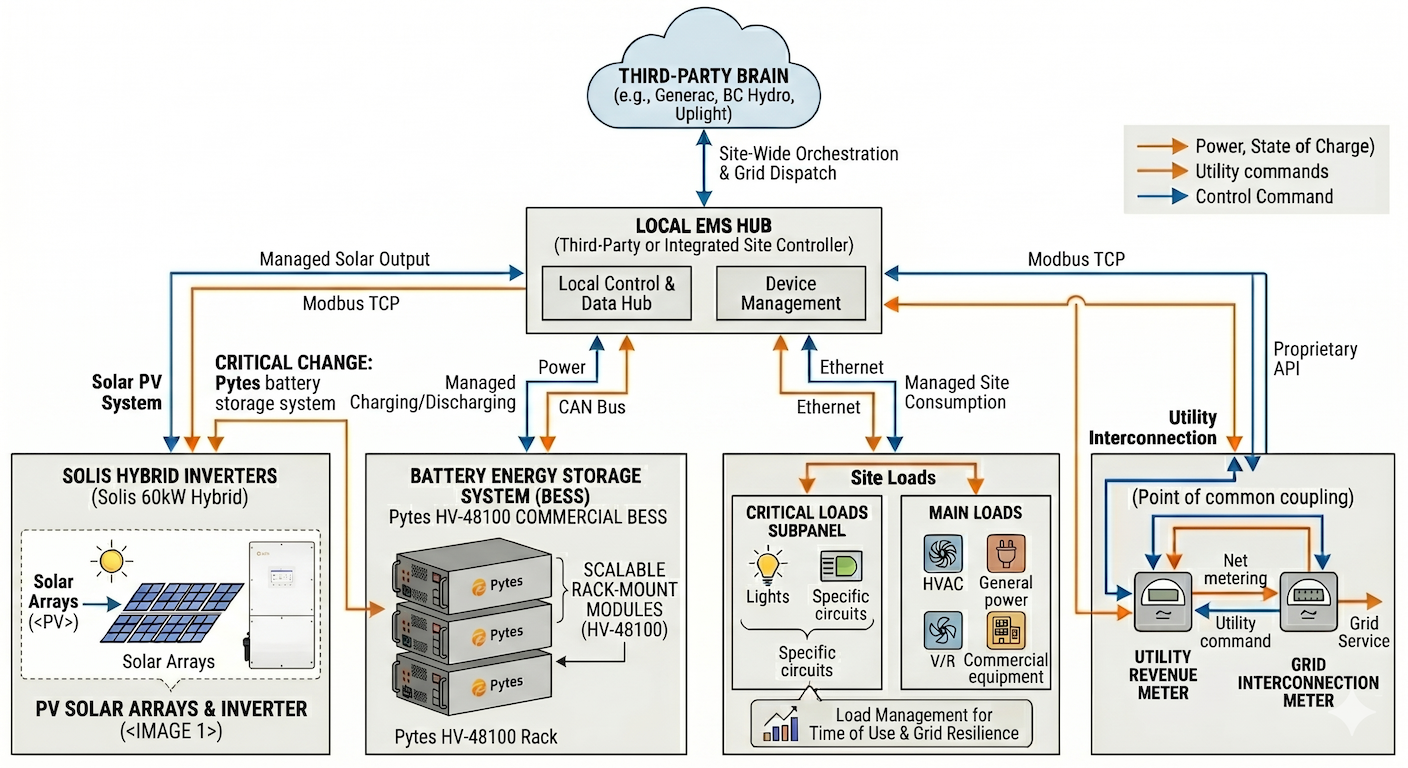
When a site scales up in complexity—requiring the orchestration of multiple distinct energy assets beyond the PV and storage—a specialized, third-party EMS is required. You will need to engage an external EMS provider if your project includes:
Integration with EV charging infrastructure.
Control and coordination of standby diesel or natural gas generators.
Complex microgrid controls combining AC-coupled PV and secondary battery systems.
Advanced, site-wide automated demand response (ADR) events dictated by utility aggregators.
Holistic control of heavy facility loads (HVAC, industrial machinery) alongside energy generation.
EMS Partners
To ensure our commercial hybrid inverters can integrate seamlessly into these highly complex sites, we work closely with top-tier third-party EMS providers, including Wattmore and Ageto (Generac Power Systems). Integrating a Solis inverter with a comprehensive EMS from one of these partners allows for site-wide asset orchestration, unlocking advanced grid services, deeper facility control, and new revenue streams.
Other EMS providers that are able to control the Solis inverter(s) through Modbus and are familiar with Solis:
- Energy ToolBase (ETB): https://www.energytoolbase.com/
- AlsoEnergy: https://home.alsoenergy.com/
- Meteocontrol: https://www.meteocontrol.com/en/
Wattmore: Next Steps - The Project Intake Form
If your upcoming project falls into the complex category requiring a third-party EMS, proper planning is essential. To evaluate your site's specific requirements and ensure seamless integration with our partners, please fill out the Project Intake Form attached to this article. Completing this form early in the design phase ensures our engineering teams can align your hardware needs with the right site-wide control strategy.
Hardware for EMS Integration
To implement these advanced site-wide controls, Solis pairs with a few different third-party EMS controllers: Wattmore’s Intellect Operate and Generac’s Microgrid ARC Controller Cabinets.
Wattmore’s Intellect Operate: Wattmore provides a hardware-agnostic EMS and SCADA platform built for ultimate integration flexibility. It connects seamlessly with site-wide components—including weather stations, backup generators, HVAC, and switchgear—using communication protocols like Modbus, DNP3, and CAN Bus. Intellect Operate utilizes AI-driven analytics to produce 24-hour energy generation, usage, and pricing forecasts every 15 minutes. This allows the system to execute automated, real-time dispatch schedules that maximize market revenue and energy savings. For sites requiring stringent protection, Wattmore's hardware incorporates multi-factor authentication, physical intrusion alarms, and optional biometric access control.
Generac’s Microgrid ARC Cabinets: Generac offers two hardware tiers depending on your project's needs. The ARC Pro Cabinet is the most capable and durable hardware option for this solution, featuring an active cooling system for installation in extreme environments and a built-in touchscreen for increased ease of operation and on-site access. For projects that have less complexity and fewer assets, the standard ARC Cabinet provides a lighter weight and more compact alternative. It maintains the same software solution and remote access capabilities as the ARC Pro, utilizing a simplified, secure design.
Crucially, stepping up to a third-party EMS does not mean losing native visibility. The Solis commercial hybrid inverter is designed to communicate with two separate monitoring platforms simultaneously, allowing site operators to monitor overarching site performance and asset orchestration via the Wattmore or Generac platform while retaining granular inverter diagnostics directly within SolisCloud.
Was this article helpful?
That’s Great!
Thank you for your feedback
Sorry! We couldn't be helpful
Thank you for your feedback
Feedback sent
We appreciate your effort and will try to fix the article