This article only applies to the the following models:
- S6-EH3P30K03-LV-YD-H-US(21A)
- S6-EH3P75K10-LV-YD-H-US
The Solis S6 Advanced Power Commercial Hybrid Inverter line includes a dedicated model engineered specifically to interface with 208V and 240V three-phase grid services. The "LV" in the model number stands for "Low Voltage" AC grid with respect to 480V being "Nominal Voltage". The other hybrid models in the same series have "NV" instead of "LV" to distinguish themselves.
While this inverter offers immense flexibility for both grid-tied energy arbitrage and off-grid backup power, its capabilities change depending on the specific phase angles and neutral configurations of the host grid. This guide clarifies the operational boundaries and wiring requirements when connecting the Solis S6 30K-LV model to standard 208V WYE, standard 240V Delta, and 240V High-Leg Delta services.
Supported Grid Topologies
The S6-EH3P30K03-LV-YD-H-US(21A) and S6-EH3P75K10-LV-YD-H-US are compatible with the following low-voltage 3-phase grid types:
3-Phase 208V WYE
3-Phase 240V Delta
3-Phase 240V High-Leg Delta (Wild Leg)
Understanding how the inverter interacts with the neutral wire in these systems is critical for determining whether the system can support unbalanced loads and grid-forming backup capabilities.
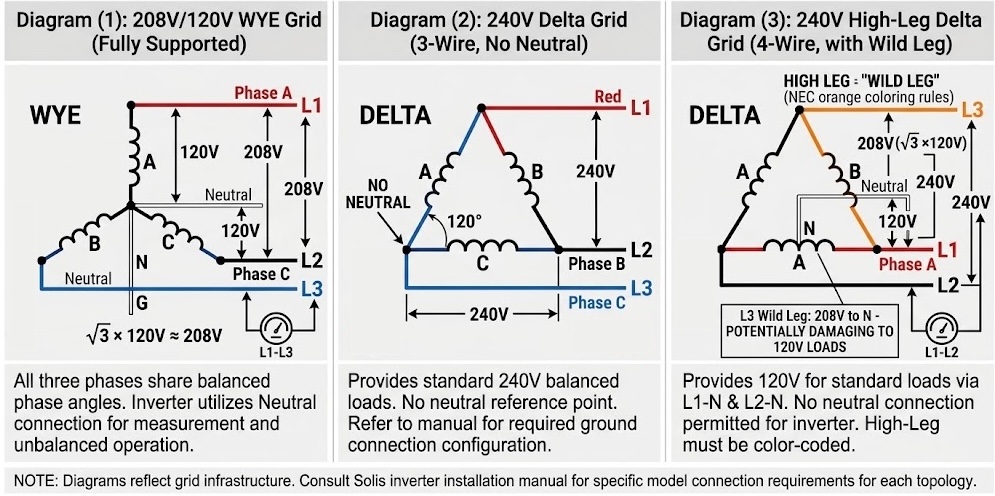
208V WYE Deployments (Full System Capability)
In standard 208V/120V WYE configurations, all three phases share balanced phase angles relative to the neutral.
Neutral Connection: Customers can and must connect the neutral (N) line to the inverter.
Grid-Tied Operation: Fully supported for peak shaving, time-of-use (TOU), and self-use energy arbitrage.
Backup Power (Grid-Forming): The inverter fully supports backup capabilities and can provide power when connected to a 208V WYE grid.
Unbalanced Output: Because the neutral line is connected, the inverter is capable of supporting three-phase unbalanced output loads on the backup port. Unbalance load can be only 33% unbalance.
For WYE grids, the S6 30K-LV functions as a complete all-in-one solution, effortlessly managing load demands while providing resilient backup power.
240V Delta Deployments (3-Wire, No Neutral)
A standard 3-wire 240V Delta grid delivers 240V phase-to-phase across all three lines but lacks a center-tapped or grounded neutral reference point.
When deploying the S6-EH3P30K03-LV-YD-H-US(21A) or S6-EH3P75K10-LV-YD-H-US on a 3-wire 240V Delta service, the installation must adhere to the following operational parameters:
Neutral Connection Prohibition: Because the grid infrastructure provides no neutral conductor, the neutral (N) terminal on the inverter must remain empty.
Energy Arbitrage Only: Without a neutral reference, the inverter is strictly limited to grid-tied operations such as peak shaving and time-of-use energy arbitrage. It cannot be utilized for grid-forming (backup) operations.
No Unbalanced Output: The physical absence of a neutral connection prevents the inverter from managing three-phase unbalanced output loads. For applications where only the grid is connected, the load unbalance is handled by the grid, not the inverter.
Grounding Requirements: While there is no neutral wire, a dedicated equipment ground (G) must be securely landed in accordance with the specific grounding configurations outlined in the installation manual to ensure safe operation.
240V High-Leg Delta Deployments (Grid-Tied Arbitrage Only)
A 240V High-Leg Delta system features a center-tapped neutral on one winding, creating two 120V phases and one phase measuring 208V to neutral (the high leg).
The S6-EH3P30K03-LV-YD-H-US(21A) and S6-EH3P75K10-LV-YD-H-US can be safely connected to a 240V High-Leg Delta grid on the Grid Port, but it requires strict adherence to the following operational limitations:
No Backup / No Grid-Forming: The grid-forming (backup) feature cannot be utilized on a 240V High-Leg Delta grid.
Energy Arbitrage Only: The inverter is strictly limited to grid-tied energy arbitrage operations.
Neutral Connection Prohibition: The neutral (N) line cannot be connected to the inverter in a High-Leg Delta setup.
No Unbalanced Output: Without connecting the neutral line, it is impossible for the inverter to achieve three-phase unbalanced output. For applications where only the grid is connected, the load unbalance is handled by the grid, not the inverter.
System Design and Commissioning Takeaways
When designing a commercial energy storage system utilizing the Solis 30K-LV or 75K-LV hybrid inverter, installers must thoroughly evaluate the site's electrical service prior to finalizing the system scope.
Site Assessment: Use a multimeter to verify line-to-neutral voltages. If L1 and L2 read 120V while L3 reads 208V, the site has a High-Leg Delta service.
Setting Customer Expectations: If High-Leg Delta is present, inform the client that the Solis battery system will deliver excellent ROI through grid-tied energy arbitrage, but it cannot act as a backup power supply during an outage.
Wiring the AC Grid Port: For WYE grids, land L1, L2, L3, Neutral, and Ground securely. For High-Leg Delta grids, only land L1, L2, L3, and Ground, explicitly omitting the neutral.
Was this article helpful?
That’s Great!
Thank you for your feedback
Sorry! We couldn't be helpful
Thank you for your feedback
Feedback sent
We appreciate your effort and will try to fix the article